Posts

Showing posts with the label Compound Annual Growth Rates
Image
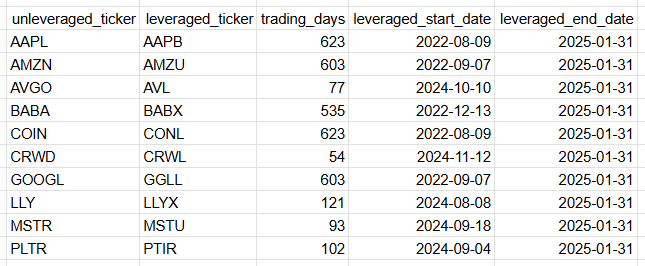
  What are Single-Stock ETFs and Should I Invest in Them? Single-stock ETFs are different than traditional ETFs.  Traditional ETFs offer a single security that tracks a collection of stocks,  but the collection of stocks can be bought and sold like a single security.  The collection of stocks underlying a traditional ETF supports diversification and thereby mitigates the risks associated with any one stock in the collection.  Single-stock ETFs are based on just one stock, and they do not provide the benefit of diversification available from traditional ETFs. ETFs can be geared or not geared.  A geared ETF aims to return a price change that is 1.5, 2, 3 or some other multiple value on the ETF’s price change during a day.  Therefore, if an ETF’s price change is +2 percent and the gear ratio is 2,  the geared ETF’s price rises by 4 percent on that trading day.  In contrast, if an ETF’s price change is -2 percent on a trading day and the gear rat...
Image
  Compound Annual Growth Rates for Leveraged Versus Unleveraged Exchange Traded Funds Exchanged Traded Funds (ETFs) offer self-directed investors an easy-to-use tool for growing their net worth.   You can think of an ETF as a basket of securities that can be bought and sold just like the stock shares for an individual company.   If the basket of securities for an ETF goes up over time, then shares for the ETF shares can also rise.   Of course, ETF share prices can also decline over time when their underlying basket of securities fail to rise or even just do not grow from their purchase price.   The objective for self-directed investors who want to grow their net worth with ETFs is to invest and hold shares in ETFs whose prices are increasing instead of declining most of the time. Leveraged ETFs are designed for investors who seek to have their invested net worth grow faster than an underlying basket of securities.   The greater the leverage for an ETF, th...