Posts

Image
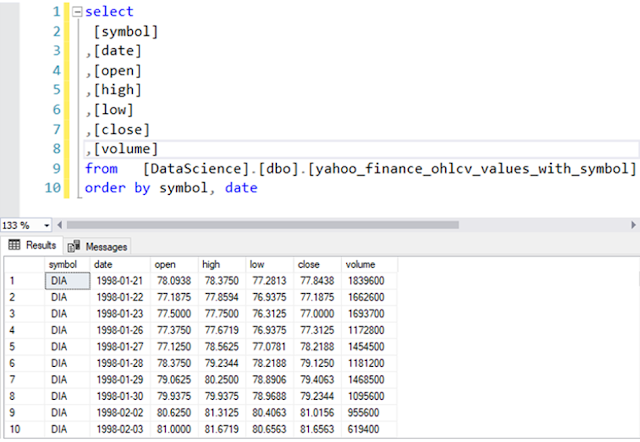
  Bitcoin USD Exchange Rates Versus Major Market ETFs During my early years as a developer, I encountered an executive who would often shout “developers, developers, developers…” at the beginning of his conference presentations until he turned red in the face or ran out of breath.   He retired as a very rich person.   This experience motivates me to write “bitcoins, bitcoins, bitcoins…” because the post is meant to move data analysts along the path to enjoying a rich, fulfilling, and early retirement via bitcoin investing. The BTC-USD ticker at the Yahoo Finance site tracks the price of a bitcoin in US dollars.   The bitcoin.org website describes bitcoins as a new kind of money (store of value) on its home page; bitcoins exist on the internet in a blockchain network. The network enables bitcoin miners to track bitcoin ownership between those owning bitcoins and those accepting bitcoins in exchange for goods and/or services.   Bitcoin miners are rewarded w...
Image
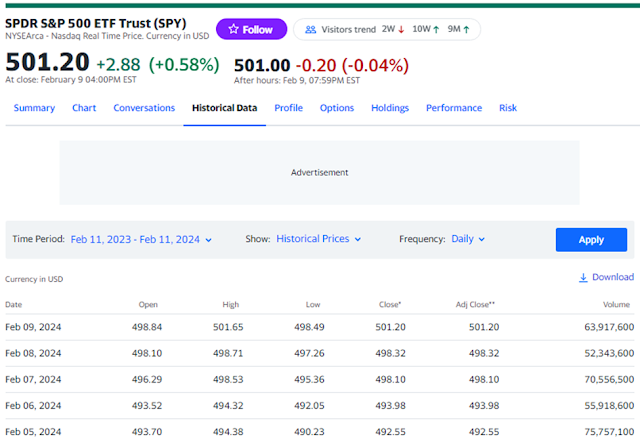
  How to Download and Display Historical Price and Volume Data   Data are the lifeblood of analytics, and this post aims to give you an introduction to downloading historical price and volume data from Yahoo Finance.   Google’s Gemini app claims that the Yahoo Finance site   attracts as many as 100 million visitors per month.   Some reasons for this degree of popularity may be because the site offers free news videos, price quotes, and historical data.   It also offers a premium line of services in addition to its free services.   After you collect historical data, you can analyze the data by transferring them to your favorite analytics package.   This post includes simple demonstrations for how to transfer historical data downloaded from Yahoo Finance to three different popular analytics packages (i.e., Excel, SQL Server, and Python). What kind of historical data will you learn to download? The following screenshot shows an example of th...
Image
Can Leveraged ETFs Safely Grow Long-Term Investments?   This post compares the performance of five pairs of ETFs.   Within each pair is an unleveraged ETF and a leveraged ETF based on five different market indexes.   Read on to learn if leveraged ETFs consistently outperformed unleveraged ETFs in the long run. The ETFs are compared over three different timeframes: since the ETF initially started trading (its launch date), over the last five years of trading, and over the next to last five years of trading.   By long-term investment, this post means buying-and-holding an ETF for a   period of several years or decades – not just a couple of weeks, days, or   minutes within a day.   The first of the three timeframes begins with the launch date for an ETF.   Because different ETFs can have different launch dates, the first timeframe can start on different trading dates for different ETFs. ETFs are compared in this post via their overall percen...